
OIL & GAS,
PETROCHEMICAL & REFINERIES
 Oil & Gas
Industry Overview
CQRA supports this as a NABCB-accredited Type A Inspection Body under ISO/IEC 17020. Its accredited scope covers Basic Metals and Fabricated Metal Products, Machinery and Equipment, and Electrical and Optical Equipment, so the static, rotating and electrical items within a unit or package can be inspected by one independent body under one quality system. Inspection, Expediting, Audit and Root Cause Analysis are offered together at vendor works and at the project site. Clients get early warning of gaps through one accountable point of contact.
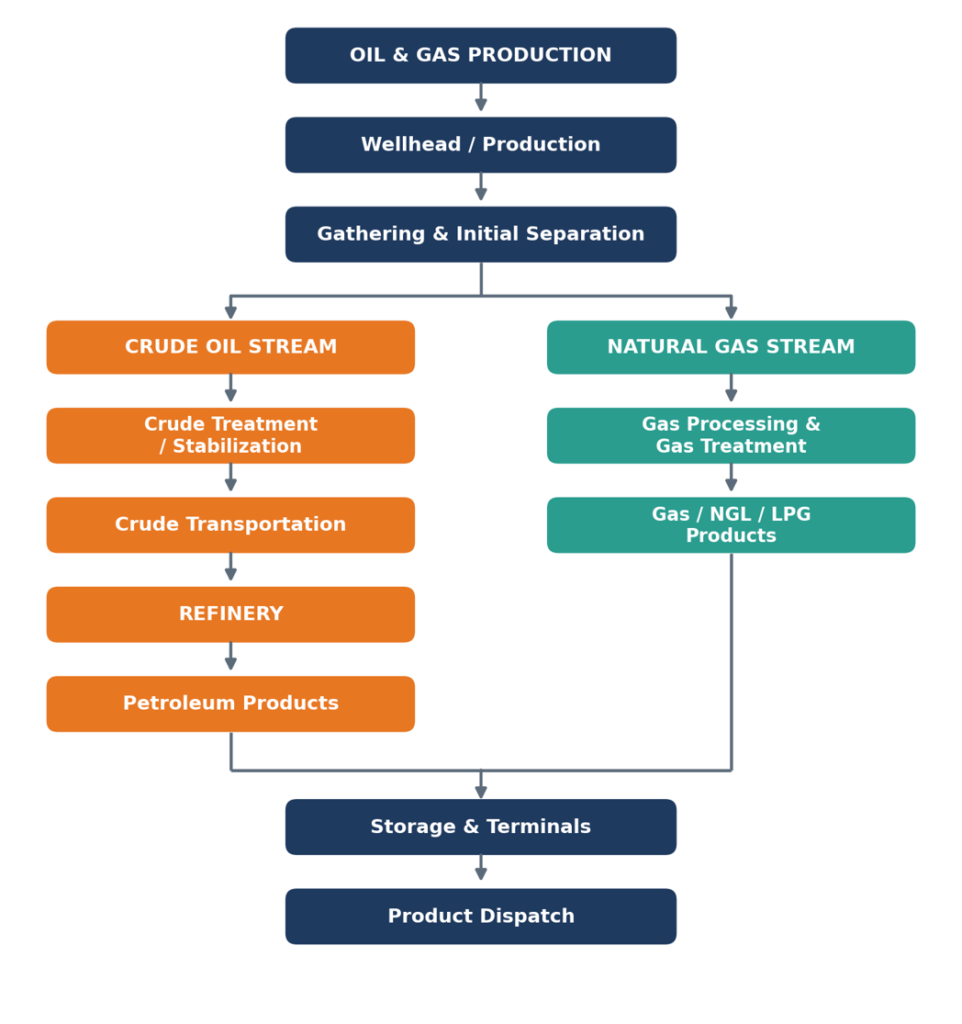
Major Units, Facilities, Systems & Packages
The following classification represents the major physical / process constituents of the Oil & Gas, Petrochemical & Refineries value chain.
1. Upstream Oil & Gas
- Wellhead & Production Facilities
- Gathering Facilities
- Field Processing Facilities
2. Gas Processing & Treatment
- Inlet & Separation Facilities
- Gas Compression
- Gas Sweetening
- Gas Dehydration
- NGL / LPG Recovery & Fractionation
- Gas Export & Product Handling
3. Refineries
- Primary Processing Units
- Conversion / Upgrading Units
- Hydro processing Units
- Reforming & Octane Improvement
- Gas & Sulphur Processing
- Hydrogen Facilities
- Product Blending & Handling
- Refinery Storage & Off-Sites
4. Petrochemical Plants
- Feedstock Preparation
- Olefin Production
- Aromatics Production
- Polymer & Derivatives Production
- Chemical Conversion
- Product Storage & Dispatch
5. Transportation & Pipeline Infrastructure
- Pipeline Systems
- Pumping & Compression Facilities
- Pipeline Terminal Facilities
- Pipeline Integrity & Associated Facilities
6. Storage & Terminals
- Hydrocarbon Storage
- Terminal Facilities
- Transfer & Loading Systems
7. Utilities & Off-Site Facilities
- Steam & Power
- Cooling & Water Systems
- Gas & Air Systems
- Environmental & Wastewater Systems
- Fire & Emergency Systems
8. Brownfield / Revamp / Shutdown Projects
- Plant Modification & Expansion
- Equipment Replacement & Upgrade
- Shutdown / Turnaround
- Recommissioning
1. Upstream Oil & Gas
1.1 Wellhead & Production Facilities
- Wellhead / Christmas Tree Systems
- Wellhead Manifolds
- Production Manifolds
- Choke Systems
- Flowlines
- Production Headers
- Production Valves and Piping
- Well Testing Facilities
1.2 Gathering Facilities
- Oil & Gas Gathering Systems
- Gathering Lines
- Gathering Manifolds
- Production Separators
- Test Separators
- Free Water Knockout (FWKO) Units
- Heater Treaters, where applicable
- Crude / Condensate Collection Facilities
- Gathering Compression Facilities
1.3 Field Processing Facilities
- Oil Separation Systems
- Gas Separation Systems
- Crude Stabilization Units
- Produced Water Treatment Systems
- Gas Dehydration Systems, where applicable
- Field Gas Compression Systems
- Chemical Injection Systems
- Crude / Condensate Storage Facilities
2. Gas Processing & Treatment
Gas processing plants make raw gas from the field fit for sale and transport. They separate liquids, remove acid gases and water through sweetening and dehydration, recover NGL / LPG and condensate, and deliver conditioned sales gas and liquid products for export and storage.
2.1 Inlet & Separation Facilities
- Inlet Reception Facilities
- Inlet Slug Catchers
- Inlet Separators
- Filter Separators
- Condensate Separation Systems
- Condensate Stabilization Systems
2.2 Gas Compression
- Inlet Gas Compression Units
- Interstage Compression Systems
- Sales Gas Compression Units
- Compressor Station Facilities
- Gas Cooling / Condensation Systems
2.3 Gas Sweetening
- Amine Gas Treating Units
- Acid Gas Removal Systems
- Amine Regeneration Systems
- Acid Gas Handling Systems
2.4 Gas Dehydration
- Glycol Dehydration Units
- Molecular Sieve Dehydration Units
- Regeneration Systems
2.5 NGL / LPG Recovery & Fractionation
- NGL Recovery Units
- Cryogenic Recovery Units, where applicable
- LPG Recovery Units
- NGL Fractionation Units
- Deethanizer / Depropanizer / Debutanizer Units, where applicable
- Condensate Stabilization Units
2.6 Gas Export & Product Handling
- Sales Gas Metering Facilities
- Gas Export Facilities
- LPG Storage Facilities
- NGL Storage Facilities
- Product Loading Facilities
3. Refineries
Refineries convert crude oil into finished petroleum products. Crude is separated by distillation, heavier fractions are upgraded through conversion and hydroprocessing units, and the products are treated, blended and sent to storage, supported by hydrogen, sulphur recovery and off-site facilities.
3.1 Primary Processing Units
- Crude Distillation Unit (CDU)
- Vacuum Distillation Unit (VDU)
- Crude Desalting System
- Atmospheric / Vacuum Fractionation Systems
3.2 Conversion / Upgrading Units
- Fluid Catalytic Cracking Unit (FCCU)
- Hydrocracking Unit
- Thermal Cracking Unit
- Delayed Coking Unit
- Visbreaking Unit
- Residue Upgrading Units
3.3 Hydroprocessing Units
- Naphtha Hydrotreating Unit
- Diesel / Gas Oil Hydrotreating Units
- Kerosene / Jet Fuel Hydrotreating Units
- Residue Hydrotreating Units
- Hydrodesulphurization Units
- Hydrocracking Units
3.4 Reforming & Octane Improvement
- Catalytic Reforming Unit
- Isomerization Unit
- Alkylation Unit
- Naphtha Splitter Unit
3.5 Gas & Sulphur Processing
- Refinery Gas Treating Units
- Amine Treating Units
- Sour Water Stripper Units
- Sulphur Recovery Units
- Tail Gas Treatment Units
- LPG Recovery / Treatment Units
3.6 Hydrogen Facilities
- Hydrogen Generation Units
- Hydrogen Purification Systems
- Hydrogen Compression Systems
- Hydrogen Distribution Systems
3.7 Product Blending & Handling
- Gasoline Blending Systems
- Diesel / Gasoil Blending Systems
- Product Blending Facilities
- Product Transfer Systems
- Product Loading Facilities
3.8 Refinery Storage & Off-Sites
- Crude Oil Tank Farm
- Intermediate / Slop Tank Farm
- Product Tank Farm
- LPG Storage Facilities
- Flare Systems
- Cooling Water Systems
- Steam Generation Systems
- Boiler Facilities
- Water Treatment Facilities
- Effluent Treatment Facilities
4. Petrochemical Plants
Petrochemical plants convert hydrocarbon feedstocks into chemicals and polymers. Feedstock is prepared and processed into olefins and aromatics, further converted into chemical derivatives and polymers, and the finished products are stored, packed and dispatched.
4.1 Feedstock Preparation
- Feedstock Storage Facilities
- Feedstock Treatment Units
- Feedstock Separation Systems
- Feedstock Conditioning Systems
4.2 Olefin Production
- Steam Cracker Units
- Ethylene Recovery Units
- Propylene Recovery Systems
- Cracked Gas Compression Systems
- Cracked Gas Separation / Fractionation Systems
4.3 Aromatics Production
- Aromatics Extraction Units
- BTX Separation Units
- Reformate Processing Units
- Aromatics Fractionation Systems
4.4 Polymer & Derivatives Production
- Polymerisation Units
- Polyethylene Units
- Polypropylene Units
- Polymer Finishing Systems
- Pelletizing Systems
- Polymer Product Handling Systems
4.5 Chemical Conversion
- Chemical Reaction Units
- Hydrogenation Units
- Oxidation Units
- Separation / Purification Units
- Solvent Recovery Systems
- Product Fractionation Units
4.6 Product Storage & Dispatch
- Chemical Storage Facilities
- Product Storage Tanks
- Silos / Solid Product Storage
- Product Packaging Systems
- Loading / Dispatch Facilities
5. Transportation & Pipeline Infrastructure
This infrastructure moves crude oil, natural gas, products and NGL / LPG between fields, plants, refineries and terminals. Pump and compressor stations provide the pressure, metering and regulation stations control and measure flow, and integrity systems such as cathodic protection and leak detection keep the lines safe.
5.1 Pipeline Systems
- Crude Oil Pipeline Systems
- Natural Gas Pipeline Systems
- Product Pipeline Systems
- NGL / LPG Pipeline Systems
- Gathering Pipelines
- Transmission Pipelines
5.2 Pumping & Compression Facilities
- Pipeline Pump Stations
- Booster Pump Stations
- Compressor Stations
- Metering & Regulation Stations
5.3 Pipeline Terminal Facilities
- Pig Launcher Facilities
- Pig Receiver Facilities
- Pipeline Metering Systems
- Filtration Systems
- Pressure Control Systems
- Surge Protection Systems
- Chemical Injection Systems
5.4 Pipeline Integrity & Associated Facilities
- Cathodic Protection Systems
- Leak Detection Systems
- Pipeline Monitoring Systems
- Valve Stations
- Block Valve Facilities
- Drain / Vent Systems
6. Storage & Terminals
Storage and terminals receive, hold and dispatch hydrocarbons – crude oil, products, LPG, NGL and condensate. Tank farms act as the buffer between production, processing and delivery, while loading and transfer systems move product to and from ships, trucks and rail.
6.1 Hydrocarbon Storage
- Crude Oil Storage Tank Farms
- Product Storage Tank Farms
- Intermediate Storage Facilities
- LPG Storage Facilities
- NGL Storage Facilities
- Condensate Storage Facilities
6.2 Terminal Facilities
- Receiving Terminals
- Export Terminals
- Import Terminals
- Marine Terminals
- Truck Loading Terminals
- Rail Loading / Unloading Facilities
6.3 Transfer & Loading Systems
- Product Transfer Systems
- Loading Arms
- Truck Loading Systems
- Marine Loading Systems
- Metering Systems
- Pumping Systems
- Vapour Recovery Systems
7. Utilities & Off-Site Facilities
Utilities and off-site facilities support the process units rather than process hydrocarbons themselves. They supply steam, power, cooling and process water, instrument and plant air, nitrogen and fuel gas, and handle effluent, waste and fire protection, keeping the plant running safely and continuously.
7.1 Steam & Power
- Boiler Units
- Steam Generation Systems
- Steam Distribution Systems
- Captive Power Generation Facilities
- Emergency Power Systems
- Electrical Distribution Systems
7.2 Cooling & Water Systems
- Cooling Water Systems
- Cooling Towers
- Raw Water Treatment
- Demineralization / DM Water Systems
- Reverse Osmosis Systems
- Process Water Systems
7.3 Gas & Air Systems
- Instrument Air Systems
- Plant Air Systems
- Nitrogen Generation / Distribution Systems
- Fuel Gas Systems
7.4 Environmental & Wastewater Systems
- Effluent Treatment Plants
- Wastewater Treatment Systems
- Sewage Treatment Systems
- Oily Water Treatment Systems
- Sludge Handling Systems
- Waste Management Facilities
7.5 Fire & Emergency Systems
- Fire Water Storage
- Fire Water Pump Houses
- Fire Hydrant Systems
- Fire Fighting Systems
- Foam Systems
- Emergency Response Facilities
8. Brownfield / Revamp / Shutdown Projects
Brownfield work is carried out on existing, operating plants rather than new ones. It covers modification and expansion of units, replacement and upgrade of equipment, and planned shutdowns / turnarounds for inspection and maintenance, followed by recommissioning to bring systems back into service.
8.1 Plant Modification & Expansion
- Process Unit Modification
- Capacity Expansion
- New Equipment Installation
- Piping Modification
- Utility System Modification
- Electrical System Modification
- Instrumentation / Control System Modification
8.2 Equipment Replacement & Upgrade
- Static Equipment Replacement
- Rotating Equipment Replacement
- Heat Exchanger Replacement
- Pump / Compressor Replacement
- Tank Modification / Replacement
- Valve Replacement
- Electrical Equipment Upgrade
8.3 Shutdown / Turnaround
- Refinery Turnaround
- Petrochemical Plant Shutdown
- Inspection & Maintenance Activities
- Equipment Overhaul
- Piping Inspection / Modification
- Pressure Testing
- Reinstatement & Recommissioning
8.4 Recommissioning
- System Flushing
- Pressure / Leak Testing
- Equipment Reinstatement
- Functional Testing
- Pre-Commissioning
- Commissioning Support
Sector wise Commodity Scope
Across the Oil & Gas, Petrochemical & Refineries sector, the major materials, equipment and electrical items encountered within CQRA’s applicable inspection scope can be broadly classified under SS17, SS18 and SS19.
These categories are common across upstream facilities, gas processing and treatment plants, refineries, petrochemical complexes, pipeline infrastructure, storage terminals, utility / off-site facilities and brownfield / revamp projects.
The applicable SS17, SS18 or SS19 classification is determined by the specific material, equipment or electrical item being inspected, rather than by the process facility in which it is installed.
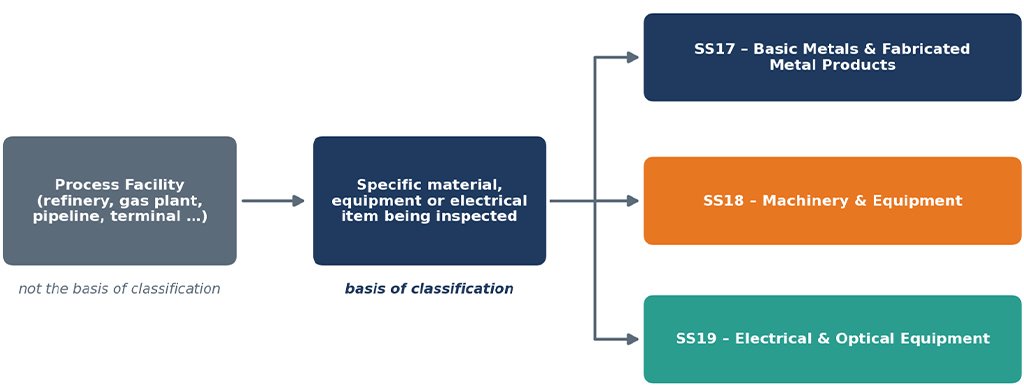
Classification Matrix
SS17
Basic Metals & Fabricated Metal Products
- Raw Materials
- Piping Components
- Fabricated Steel Products
- Static & Pressure Equipment
- Welding & Fabrication
SS18
- Valves
- Rotating Equipment
- Lifting & Material Handling Equipment
- Measuring & Instrumentation Equipment
- Skid-Mounted / Vendor Package Equipment
SS19
Electrical & Optical Equipment
- Power Generation & Backup Power
- Transformers & Power Distribution
- Electrical Machines
- Cables & Electrical Protection
- Earthing & Lightning Protection
SS17 – Basic Metals & Fabricated Metal Products
SS17 – Basic Metals & Fabricated Metal Products covers the following categories of materials, equipment and electrical items within CQRA’s applicable inspection scope: Raw Materials, Piping Components, Fabricated Steel Products, Static & Pressure Equipment and Welding & Fabrication. The items under each category are listed below.
Raw Materials
- Plates & Sheets
- Pipes & Tubes
- Bars
- Forgings
- Castings
Piping Components
- Pipe Fittings
- Flanges
- Fasteners
- Gaskets
- Other applicable bought-out metallic piping components
Fabricated Steel Products
- Structural Steel
- Columns & Beams
- Bracings
- Pipe Racks
- Platforms
- Walkways & Gratings
- Equipment Supports
- Frames
- Fabricated Skids / Structures, where applicable
Static & Pressure Equipment
- Pressure Vessels
- Process Columns / Towers
- Drums
- Separators
- Reactors
- Heat Exchangers
- Condensers
- Coolers
- Storage Tanks
- LPG / Hydrocarbon Storage Bullets
Welding & Fabrication
- Welded Fabrication
- Welding-related Inspection
- Welding Procedure / Qualification Documentation
- Welder Qualification Documentation
- NDT and associated fabrication quality records
SS18 – Machinery & Equipment
SS18 – Machinery & Equipment covers the following categories of materials, equipment and electrical items within CQRA’s applicable inspection scope: Valves, Rotating Equipment, Lifting & Material Handling Equipment, Measuring & Instrumentation Equipment and Skid-Mounted / Vendor Package Equipment. The items under each category are listed below.
Valves
- Gate Valves
- Globe Valves
- Check Valves
- Ball Valves
- Butterfly Valves
- Control Valves
- Other applicable process / mechanical valves
Rotating Equipment
- Centrifugal Pumps
- Positive Displacement Pumps
- Reciprocating Pumps
- Compressors
- Centrifugal Compressors
- Reciprocating Compressors
- Blowers
- Fans
Lifting & Material Handling Equipment
- EOT Cranes
- Gantry Cranes
- Jib Cranes
- Hoists
- Applicable Lifting Equipment
- Applicable Lifting Accessories
Measuring & Instrumentation Equipment
- Pressure Measurement Equipment
- Temperature Measurement Equipment
- Flow Measurement Equipment
- Level Measurement Equipment
- Process Measurement Equipment
- Applicable Metering Equipment
Skid-Mounted / Vendor Package Equipment
- Pump Packages
- Compressor Packages
- Chemical Injection Packages
- Lube Oil Packages
- Seal Oil / Seal Gas Packages
- Fuel Gas Packages
- Filtration Packages
- Metering Skids
- Other applicable skid-mounted machinery / equipment within the accredited scope
SS19 – Electrical & Optical Equipment
SS19 – Electrical & Optical Equipment covers the following categories of materials, equipment and electrical items within CQRA’s applicable inspection scope: Power Generation & Backup Power, Transformers & Power Distribution, Electrical Machines, Cables & Electrical Protection and Earthing & Lightning Protection. The items under each category are listed below.
Power Generation & Backup Power
- Generators
- DG Sets
- UPS Systems
- Applicable Backup Power Equipment
Transformers & Power Distribution
- Power Transformers
- Distribution Transformers
- LV Switchgear
- MV Switchgear
- Electrical Panels
- Distribution Boards
Electrical Machines
- Motors
- Applicable Electrical Drives
- Other applicable electrical machines within the accredited scope
Cables & Electrical Protection
- HV Cables
- Applicable Power Cables
- Circuit Breakers
- Protection Relays
- Electrical Protection Equipment
Earthing & Lightning Protection
- Earthing Equipment
- Lightning Protection Equipment
- Associated applicable electrical protection components

Industrial Inspection & assurance services supporting quality, compliance and effective project execution.
QUICK LINKS
SERVICES
RESOURCES
© 2026 CQRA. All Rights Reserved.